Property lines have a funny way of staying invisible until something lands on the wrong side of them. A new fence appears. A shed creeps over a few feet. Tree branches stretch farther than expected. Before long, a friendly chat can turn into weeks of tension.
Most people would rather settle a boundary issue calmly than spend money on surveyors, lawyers, or court cases. A clear, respectful letter often helps both sides slow down, focus on the facts, and find a practical answer before the disagreement grows.
Even if the problem feels frustrating, the words on paper matter. The right letter can open the door to a solution while keeping the relationship with your neighbor as civil as possible.
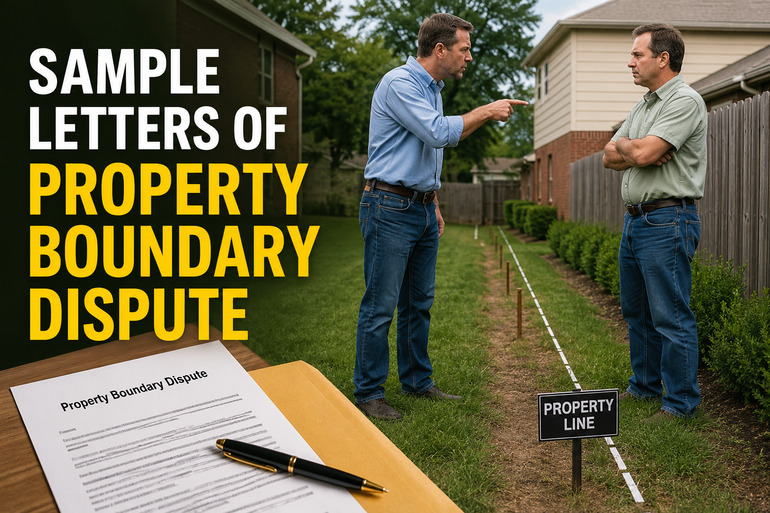
Sample Letters of Property Boundary Dispute
Every situation is different, so the samples below cover several common property boundary problems. Pick the one that fits your circumstances and adjust the names, addresses, and details before sending it.
1. Friendly Letter About a Suspected Boundary Encroachment
Date: March 14, 2026
Dear Mr. Thompson,
I hope you and your family are doing well.
I am writing regarding the new wooden fence that was recently installed between our properties at 25 and 27 Maple Avenue. After looking over my property documents, I believe a section of the fence may extend onto my property by approximately two feet.
There is every chance this is simply a misunderstanding, and I wanted to discuss it with you before taking any further steps. I believe we can settle the matter in a friendly and respectful manner.
Would you be available sometime next week to review the boundary together? If necessary, we could also arrange for a licensed surveyor to confirm the exact property line so that both of us have accurate information.
Thank you for taking the time to consider this. I appreciate your cooperation and look forward to resolving the issue together.
Sincerely,
Michael Carter
2. Letter Requesting a Joint Property Survey
Date: April 8, 2026
Dear Mrs. Evans,
I hope this letter finds you well.
Recent discussions about the location of the boundary separating our properties have shown that we may each have different information regarding the exact property line. Rather than relying on assumptions, I believe it would benefit both of us to have the boundary professionally surveyed.
I would like to suggest that we jointly hire a licensed land surveyor to inspect the properties and establish the correct boundary based on the official land records. If you agree, we could share the survey costs equally unless another arrangement seems more appropriate.
Having an independent survey completed would help avoid future misunderstandings and allow any necessary adjustments to be made with confidence.
Please let me know your thoughts within the next two weeks. I hope we can work together to settle this matter amicably.
Kind regards,
Sarah Mitchell
3. Letter Requesting Removal of an Encroaching Fence
Date: May 20, 2026
Dear Mr. Harrison,
I hope you are doing well.
I am writing regarding the fence that was recently constructed along the boundary between our properties at 112 Oak Street and 114 Oak Street.
After reviewing the property survey completed by Green Valley Surveying on May 10, 2026, it appears that approximately eighteen inches of the fence has been built inside my property line. I have enclosed a copy of the survey for your reference.
I understand that this may have happened unintentionally, and I appreciate the work that went into installing the fence. However, because the structure occupies part of my property, I kindly ask that it be relocated to the correct boundary line.
If it helps, I would be happy to meet with you and review the survey together before any work begins. My hope is that we can settle this matter without unnecessary expense or conflict.
I would appreciate hearing from you within the next fourteen days regarding your plans to address this issue.
Thank you for your understanding and cooperation.
Sincerely,
Daniel Brooks
4. Letter Regarding a Neighbor’s Building Encroaching on Your Property
Date: June 2, 2026
Dear Ms. Reynolds,
I hope everything is going well for you.
I recently noticed that the storage shed constructed near the rear of your property appears to extend beyond the property boundary and onto my land. To avoid making assumptions, I arranged for a licensed surveyor to verify the boundary.
The completed survey indicates that a portion of the shed extends approximately three feet into my property. I have enclosed a copy of the survey for your review.
I recognize that construction projects can occasionally involve mistakes, especially when boundary markers are unclear. Because of that, I wanted to contact you directly before considering any other action.
I respectfully request that the encroachment be addressed within thirty days. Whether the shed is relocated, modified, or another mutually acceptable solution is reached, I believe we can resolve the matter cooperatively.
Please let me know when it would be convenient for us to meet and discuss the available options.
Thank you for your attention to this matter. I look forward to finding a fair solution that works for both of us.
Respectfully,
Rebecca Turner
5. Letter About Trees Crossing the Property Line
Date: July 9, 2026
Dear Mr. Wilson,
I hope you have been keeping well.
I am writing about the large oak trees located near the boundary between our properties. Over the past year, several branches have grown across the property line and now extend over my driveway and part of my roof.
During recent storms, falling branches have caused minor damage to my gutters and have raised concerns about safety. While I appreciate the beauty and shade the trees provide, I believe the current situation needs attention.
Would you be willing to arrange for the overhanging branches to be professionally trimmed? I believe addressing the issue now will help prevent more serious damage in the future while preserving the health of the trees.
If you would like, we can meet to look at the affected area together before any work is arranged.
Thank you for considering my request. I appreciate your cooperation and hope we can resolve the matter amicably.
Kind regards,
Emily Foster
6. Letter Objecting to Landscaping Beyond the Boundary
Date: August 18, 2026
Dear Mrs. Peterson,
I hope you are having a pleasant week.
I recently noticed that the flower beds and decorative stone edging installed along the side of your property appear to extend onto my land. While the improvements certainly enhance the appearance of the area, I believe they cross the legal property boundary.
According to my property survey and title documents, the affected section belongs to my lot. I have attached copies of the relevant survey pages for your convenience.
I understand this may have happened without your knowledge, and I appreciate that property boundaries can sometimes be difficult to identify without professional measurements.
With that in mind, I kindly request that the landscaping materials be removed from my property within the next three weeks or that we discuss another mutually acceptable arrangement.
Please let me know a suitable time to talk. I am confident we can settle this matter respectfully.
Sincerely,
Andrew Collins
7. Letter Following an Independent Property Survey
Date: September 12, 2026
Dear Mr. Anderson,
I hope you are doing well.
I am writing to follow up on our recent conversations regarding the location of the boundary separating our properties.
Since we were unable to agree on the exact property line based on our existing documents, I arranged for a licensed land surveyor to complete a detailed survey of my property. The survey was carried out on September 5, 2026, and the results indicate that a portion of the retaining wall constructed along the boundary extends approximately twenty-four inches onto my property.
I have enclosed a copy of the survey report and the survey drawing for your review. My intention in obtaining this survey was simply to establish the facts so that both of us could work from the same information.
I understand that neither of us may have been fully aware of the precise boundary before the survey was completed. Property markers often disappear over time, previous owners sometimes install improvements without verifying lot lines, and assumptions can continue for years before anyone notices a problem.
Now that the survey has clarified the matter, I respectfully request that we discuss the most practical way to resolve the encroachment. This could involve relocating the retaining wall, modifying it so that it no longer extends onto my property, or considering another solution that both of us can accept.
My hope is to settle this issue cooperatively rather than allowing it to become a legal dispute. Good neighbors are worth far more than a disagreement over a few feet of land, and I believe respectful communication gives us the best chance of reaching an agreement.
Please contact me within the next fourteen days so that we can arrange a convenient time to meet.
Thank you for taking the time to review the enclosed survey. I appreciate your willingness to work through this matter.
Sincerely,
David Mitchell
8. Formal Notice to Stop Further Encroachment
Date: October 6, 2026
Dear Mrs. Lewis,
I hope this letter finds you well.
I am writing regarding the ongoing construction work taking place along the boundary between our properties.
During the past several weeks, I have observed workers extending a concrete pathway and beginning preparations for what appears to be a small garden wall. Based on my property records and the boundary survey completed earlier this year, the work appears to be crossing onto my property.
I previously mentioned my concerns during our conversation on September 28, and I appreciate that you took the time to listen. However, construction has continued since then, and I feel it is necessary to put my concerns in writing.
I respectfully request that all construction affecting the disputed boundary be paused until the property line has been confirmed by both parties. Continuing work before the issue is settled could make the situation much more difficult and expensive to correct later.
If you believe the current construction is entirely within your property, I would appreciate the opportunity to review the documents or survey supporting that position. Likewise, I am willing to share the survey and title documents that I have relied upon.
I sincerely hope we can avoid unnecessary disagreement. Taking a short pause now gives both of us the opportunity to verify the facts before permanent structures are completed.
If we are unable to resolve the issue through discussion, I would be willing to participate in mediation with an independent third party before considering any legal proceedings.
Please respond within ten business days so that we can decide on the next steps together.
Thank you for your attention and cooperation.
Respectfully,
Karen White
9. Letter from a Property Owner Through an Attorney
Date: November 14, 2026
Dear Mr. Collins,
Our office represents Mr. Jonathan Reed concerning the property located at 48 Willow Creek Drive.
Our client has asked us to contact you regarding an encroachment affecting the common boundary between your property and his.
A licensed survey commissioned on October 30, 2026, confirms that the detached garage recently constructed on your property extends approximately thirty inches beyond the legal property line and occupies a portion of our client’s land.
A copy of the certified survey has been enclosed for your review.
Our client would prefer to resolve this matter without litigation and has instructed us to seek an amicable solution before pursuing any legal remedies available under applicable property law.
Accordingly, we respectfully request that you contact our office within fifteen days of receiving this letter to discuss one of the following possible resolutions.
- Removal of the encroaching structure.
- Relocation of the affected portion of the building.
- Another mutually acceptable agreement reached in writing.
If we do not receive a response within the requested period, our client will evaluate the legal options available to protect his property rights. While litigation remains available, it is not the preferred course of action.
We encourage open communication and believe this matter can still be settled through cooperation and good faith discussions.
Should you have legal representation, please ask your attorney to contact our office directly.
Thank you for your prompt attention.
Sincerely,
Angela Morris
Attorney at Law
10. Final Attempt to Resolve a Property Boundary Dispute Before Legal Action
Date: December 3, 2026
Dear Mr. Bennett,
I hope you are doing well.
This letter serves as my final written attempt to resolve the ongoing property boundary dispute between our properties before pursuing any legal action.
Over the past several months, I have tried to settle this matter through friendly conversations, written correspondence, and the completion of a professional land survey. Copies of these communications and supporting documents have previously been provided to you.
The survey confirms that the masonry wall extending along the eastern side of your property occupies a portion of my land. Despite earlier discussions, the encroachment remains unchanged.
I continue to believe that this issue can be resolved without involving the courts. A voluntary agreement would save both of us considerable time, expense, and unnecessary stress.
To that end, I respectfully ask that you contact me within fourteen days of receiving this letter to discuss one of the following options.
- Removing the encroaching structure.
- Relocating the wall to the surveyed property line.
- Participating in mediation with a mutually agreed mediator.
- Exploring another written agreement that protects the interests of both property owners.
If I do not receive a response within the requested period, I will have little choice but to seek legal advice regarding the protection of my property rights. That step is one I have hoped to avoid throughout this process.
Please understand that this letter is intended to encourage one final effort at resolving the matter cooperatively. I remain willing to discuss practical solutions and hope we can settle the dispute respectfully.
Thank you for your attention. I look forward to hearing from you.
Sincerely,
Robert Hayes
Wrapping Up
Property boundary disagreements often begin with honest mistakes rather than bad intentions. An old fence may have been installed years ago without a survey. Previous owners may have relied on worn-out boundary markers. Landscaping projects, driveways, sheds, retaining walls, and even garden beds can slowly drift beyond the legal property line without anyone realizing it until a survey is completed.
That is why the tone of your first letter matters so much. A respectful letter gives the other property owner room to correct the issue without feeling attacked. It also creates a written record showing that you made a genuine effort to settle the matter peacefully.
If the dispute continues, each letter should become gradually firmer while remaining professional. Start with a friendly request. Follow that with a proposal for a joint survey if the boundary is uncertain. If a survey confirms an encroachment, send a clear request explaining what needs to be corrected and provide copies of any supporting documents. Keeping every letter factual and polite strengthens your position if the matter eventually reaches mediation or court.
Before sending any boundary dispute letter, take a few practical steps.
- Review your property’s deed, plat map, and survey.
- Gather photographs showing the disputed area.
- Keep copies of every letter, email, and message you send or receive.
- Send important correspondence using a delivery method that provides proof of receipt.
- Avoid emotional language, accusations, or personal insults.
- Focus on facts, dates, measurements, and reasonable requests.
Many disputes are settled after both parties review the same survey. Others require mediation, which is often less expensive and far quicker than litigation. Only a small percentage of boundary disagreements ultimately proceed to court, particularly when both neighbors remain willing to communicate.
No matter how frustrating the situation becomes, avoid taking matters into your own hands by removing fences, demolishing structures, or entering the other person’s property without permission. Such actions can complicate the dispute and may even expose you to legal liability, regardless of who is ultimately found to be correct about the boundary.
A carefully written letter will not solve every disagreement overnight. Still, it is often the first and most effective step. It shows that you approached the issue reasonably, gave the other party an opportunity to respond, and made every effort to settle the matter fairly before considering stronger legal remedies. Sometimes that simple act of putting everything clearly and respectfully in writing is enough to turn a difficult property dispute into a practical conversation that both neighbors can move beyond.